Perched at an elevation of 4,659 feet above sea level on the rugged cliffs of the Sahyadri range, 60 Kilometres from the ancient city of Nashik, stands the Shri Saptashrungi Nivasini Devi Temple. It is not simply a place of pilgrimage. It is the beating spiritual heart of an entire landscape, a goddess embedded not inside stone walls, but within the living rock face of a mountain, surrounded by seven peaks that have stood watch over her for centuries.
The name itself tells you everything: Sapta means seven. Shrunga means peaks.
She is the goddess who dwells among the seven mountains. And when you stand at the base of this sacred hill, looking up at the sheer cliff that rises before you, at the shrine carved into that rock face with the dense forests of the Western Ghats stretching in every direction, it is impossible not to feel that you have arrived somewhere that has always been meant to be found.
The Marathas of Maharashtra have a saying about the four great Shakti Peethas of their land, the Sade Teen Shakti Peethas, the three-and-a-half sacred seats of the divine feminine. Of those, Saptashrungi holds the unique distinction of being the ardha peetha, the half-peetha, not lesser, but original.




She goes by many names, like Saptashrungi Nivasini, Mahishasura Mardini and Bramhasvarupini. But to the people of Nashik and across Maharashtra, she is simply Devi, the mother goddess who has made these mountains her permanent home.
The Devi Bhagavata Purana mentions the Saptashringa hills as a Shakti Peetha. The Devi Mahatmya, the foundational text of goddess worship, is said to have been composed by the sage Markandeya at the very hill that faces the temple across a deep ravine. He sat in his cave and recited the Puranas for the devotee, and the goddess idol is even said to lean ever so slightly to the left towards the Markandeya hill as if it's still listening.
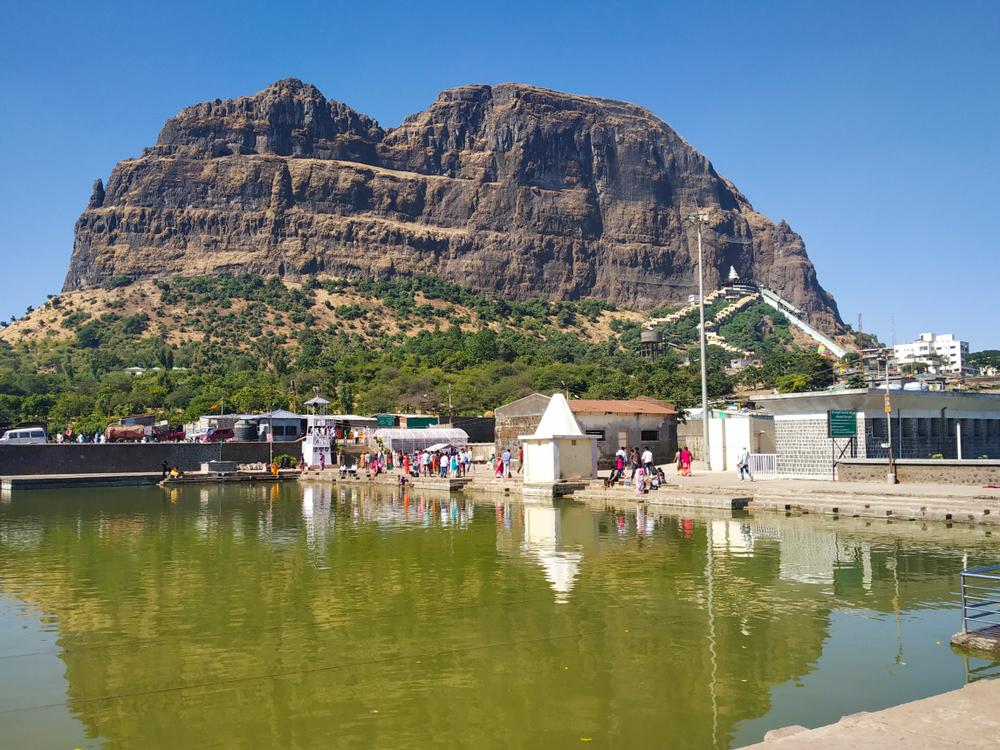
The journey to the temple from Nashik is itself a preparation. The road winds through the gentle farmlands of north Maharashtra before beginning its ascent into the Sahyadri range. The landscape shifts gradually, the air cools, the trees thicken, and the seven peaks of Saptashringa come into view against the horizon long before you reach the foothills. State Highway 17, linked with National Highway 3, connects Nashik to the village of Vani at the foot of the hills, which is the gateway to the temple.
Most devotees approach from Vani, about 26 kilometers from the temple site itself. The route from Nashik via Dindori covers roughly 39 kilometers, while the road through Pimpalgaon Baswant stretches to about 51 kilometers. The shortest approach, 14 kilometers from Vani, runs through Nadurgaon village, and it is the one most commonly taken by pilgrims arriving by road.
The forests surrounding these hills are no ordinary forests. The Sahyadri range here is known for the density of its medicinal herbs, and the 108 natural water bodies, called kundas, that are scattered across the watershed of the seven peaks, add a quality to this landscape that feels deliberately preserved. The hills are alive in a way that most places simply are not.

At the foot of the hill, before the climb begins, you encounter the first sign that something extraordinary awaits above, a large stone buffalo head, believed to represent the demon Mahishasura, placed at the very spot where the steps begin. It is a marker, a threshold. The moment you step past it and begin your ascent, you have entered sacred ground.
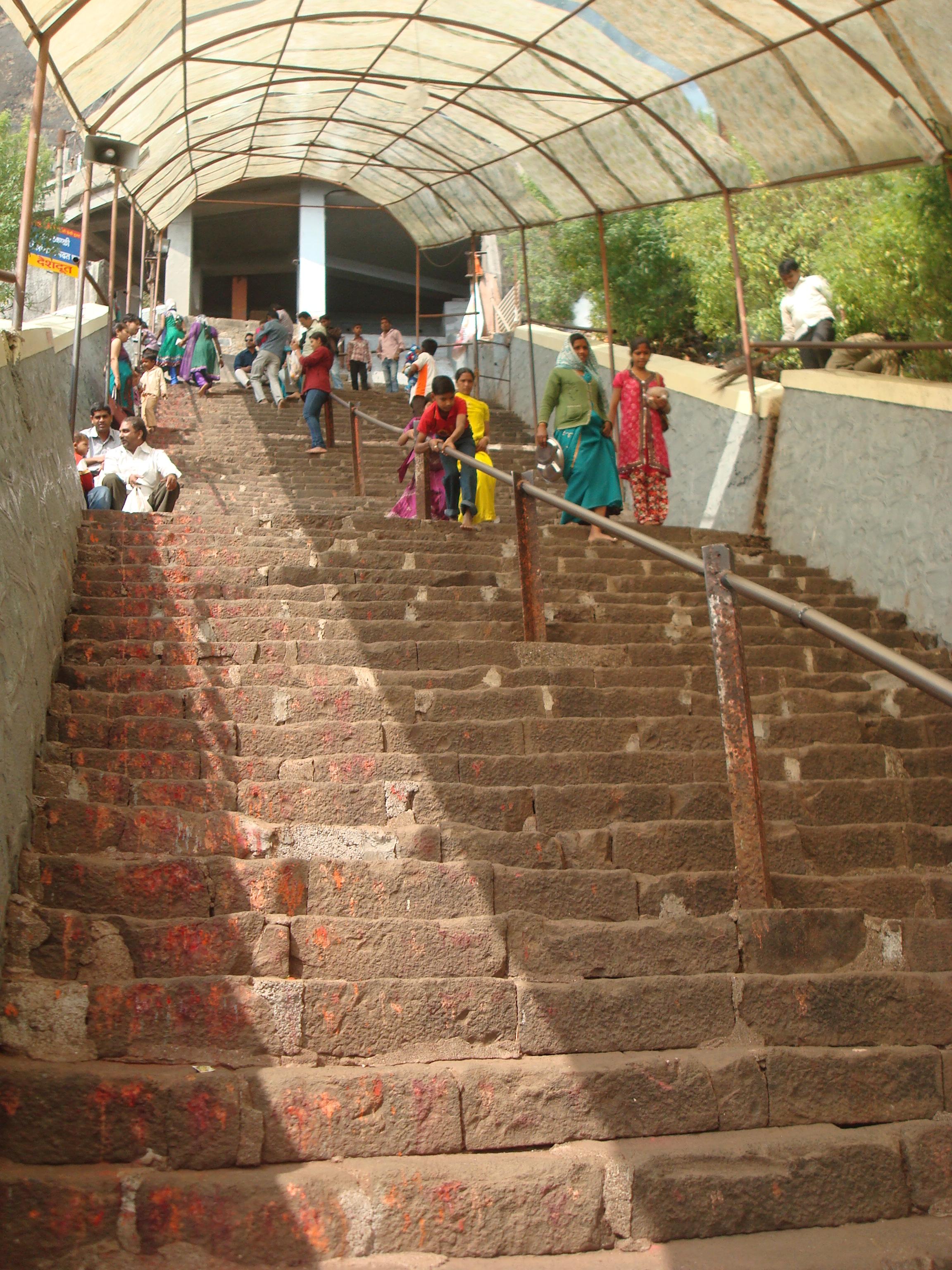
The 510 steps that lead up to the temple were built by Umbai Dabhade in 1710 AD. Umabai Dabhade was the wife of Maratha commander Khanderao Dabhade, and her patronage of this temple's infrastructure has attracted several pilgrims for over three centuries. The steps are carved directly into the rock face of the mountain. As you climb, you pass small carved figures depicting Lord Rama, Lord Hanuman, Radha, Lord Krishna and a stone tortoise with traditional markings, found in temples dedicated to Durga Mata.
The climb takes approximately 45 minutes to an hour at
a comfortable pace. As the city and the plains fall away below, the forest presses closer on either side. By the time the shrine comes into view, the two-story structure is clinging to the cliff face with the natural cave behind it. The outside world feels distant.
For those who cannot manage the steps, the temple trust introduced a funicular trolley service in 2018. With six coaches, each accommodating ten passengers, the trolley covers the ascent in approximately three minutes. It runs daily from 6:00 AM to 9:30 PM.

Saptashrungi Temple is a two-story structure built directly into and in front of a natural cave in the cliff face. The courtyard at the entrance sets the tone immediately. A tall Trishula, the sacred trident, stands adorned with bells and lamps, swaying gently in the hill breeze. The sound of the bells, the smell of incense, and the faint orange glow from the sindoor-covered idol above combine into something that pilgrims struggle to describe adequately. There is a community hall for devotees to gather in groups, and a gallery to maintain orderly darshan queues for the large numbers who arrive daily.
At the entrance to the shrine complex, a large statue of a buffalo, its head again greets you, commemorating the goddess's victory over Mahishasura. On festive days, the entire hillside surrounding the temple is lit up, and the cliff itself glows.

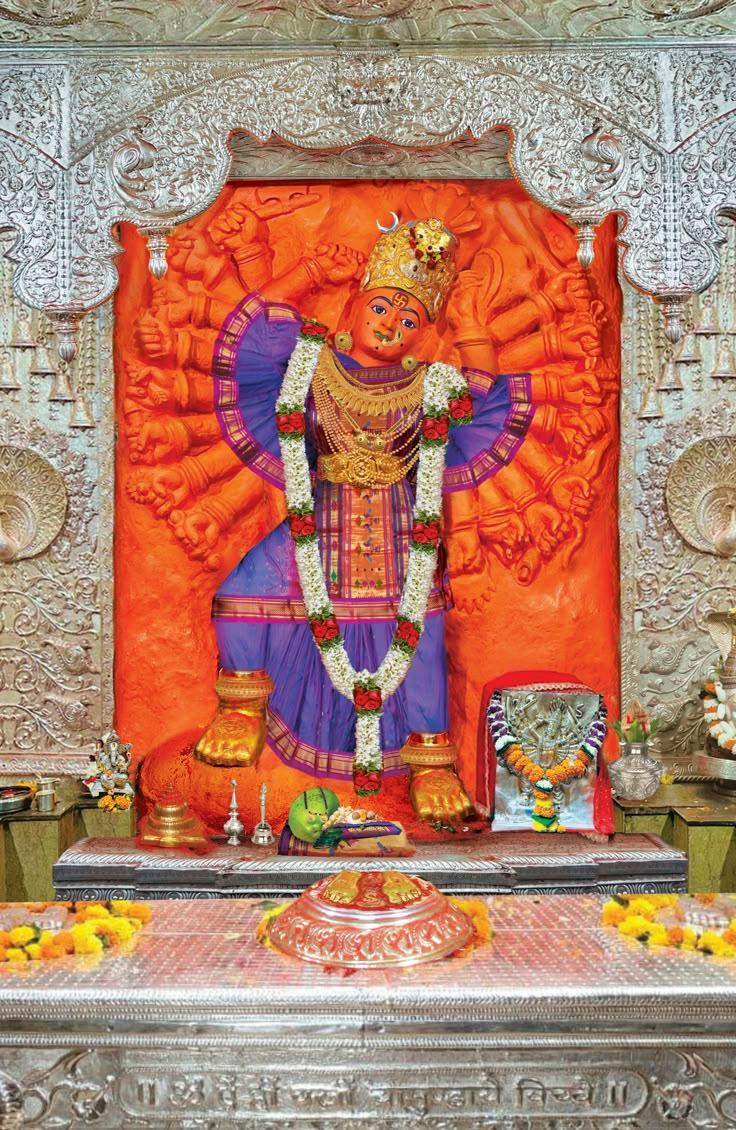
The Devi is enshrined on the upper floor of the two-story temple, housed in the natural cave at the base of the sheer cliff. When you finally reach her, the effect is overwhelming. What makes her unlike almost any other goddess in India is her form. The idol of Saptashrungi Devi is Swayambhu, which is self-manifested.
She was not carved by human hands, but emerged from the face of the mountain itself. She stands 8 ft tall, with 18 arms, 9 on each side. Each hand carries a different weapon, gifted to her by the gods. Her form is that of Mahishasura Mardini, the destroyer of evil. And her entire body is coated in bright vermillion sindoor, which gives her a burning orange appearance that is unlike anything else in the world of temple worship.
Her eyes are made of white porcelain. In the midst of all that blazing red, those eyes catch you completely. They are described by devotees who have stood before her as the eyes of someone who both sees everything and forgives everything. The fierce and the compassionate, held in the same gaze.


Saptashrungi is something rarer and more primal, being a temple built into a cliff, where the mounta...
Saptashrungi is something rarer and more primal, being a temple built into a cliff, where the mountain itself is a sanctum, and the goddess was not installed but found. The story structure in front of the cave is an addition to the original site, practical and functional and clearly secondary to the rock face behind it.
The lower floor of the structure houses the courtyard and community spaces. The upper floor is where the cave opens and where the goddess resides. The transition from the courtyard to the sanctum is deliberate and architecturally significant as you move through the building and upward, the cave tightens around you, the ceiling comes lower, and the attention narrows entirely onto the idol at the center.

The cave that forms the natural sanctum is cut into the near-vertical face of the Saptashringa cliff...
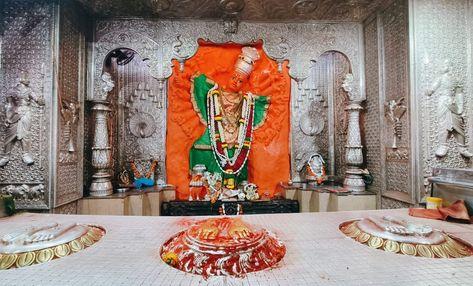
The cave that forms the natural sanctum is cut into the near-vertical face of the Saptashringa cliff. The idol of the Devi is carved in relief from the living rock, not a separate sculpture installed within the cave, but an emergence from the wall itself.
Here, the temperature drops, the sounds from outside are muffled, and the light is low and controlled. The idol fills the far wall, her eighteen arms spreading outward and her white eyes catching all the light that drops on her.

In front of the temple, in the open courtyard through which all devotees pass, stands a tall Trishul...
In front of the temple, in the open courtyard through which all devotees pass, stands a tall Trishula adorned with bells and lamps. Devotees ring the bells as they pass, and the sound carries across the hillside.
The Trishula is the symbol of Shiva, and of Shakti, the divine power that cuts through illusion, and its placement at the entrance to the goddess's home is both tradition and a statement.

The 510 steps that rise from the foothills to the temple entrance were cut from the rock itself, not...
The 510 steps that rise from the foothills to the temple entrance were cut from the rock itself, not laid stone, but the hillside hewn into a staircase. Built under the patronage of Umabai Dabhade in 1710, these steps are the primary route of devotion for pilgrims who choose to climb.
Small curved figures of deities mark intervals along the ascent, turning the climb into something closer to a walking meditation than simple exercise. The carvings include images of Rama, Hanuman, Radha Krishna and Dattatreya. The full range of the Hindu tradition is represented along the path to the goddess at the summit.

Surrounding the seven peaks of the Saptashringa range are 108 natural water bodies, called kundas. T...
Surrounding the seven peaks of the Saptashringa range are 108 natural water bodies, called kundas. These ponds and pools, fed by the Sahyadri's extraordinary capacity to retain rainfall, are considered sacred, and their number, 108, the same as the number of beads on a mala, is taken as confirmation of the divine character of this landscape. Some of the named kundas include Kalikund, Suryakund, and Dattatraya Kund.

Directly across the ravine from the Saptashrungi Temple, Markandeya Hill is the site most intimately connected with the temple's spiritual history. This is where the sage is believed to have lived, meditated, and composed the Devi Mahatmya. The cave attributed to him still exists on the hillside. The Hill offers a stunning view of the Saptashrungi cliff face opposite, and pilgrims who undertake the Parikrama.

Because the goddess's idol is carved into the hillside rather than housed in a freestanding structure, the traditional act of circumambulation, going around the deity, means circling the entire hill. The parikrama path runs at elevations between 1,230 and 1,350 meters, through steep rock formations and dense forest. This is a serious undertaking, not a casual walk, but for devoted pilgrims, it is considered the highest form of worship at Saptashrungi.

About 75 Kilometres from the Saptashrungi temple, Timbakeshwar is one of the twelve Jyotirlingas of India, the most sacred Shiva temple in the country. It sits at the source of the Godavari River, and its importance in Nashik's spiritual landscape makes it a natural companion visit for pilgrims who have come for Saptashrungi.

Located near Nashik, Anjaneri is traditionally believed to be the birthplace of Lord Hanuman. The hills are named after Anjana, his mother and the site holds a special place for devotees who connect to Saptashrungi Ramayana, linking to the broader geography of the region.