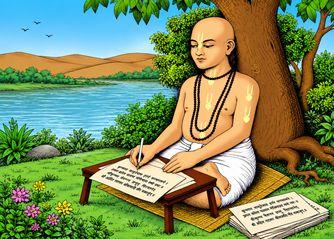


Founder of the Radharaman tradition; one of the Six Goswamis of Vrindavan. Born 1503 CE in Sri Rangam; brought the twelve Shaligram Shilas from the Gandaki river in Nepal.

Tucked inside a walled compound just beyond the northern edge of Nidhivan, the Sri Radharaman Temple does not announce itself the way many great temples do. There is no towering Shikhara, no floodlit facade.
You reach it through narrow lanes, pass through heavy wooden doors, cross a courtyard lined with the homes of Goswami families who have lived here for centuries, and arrive before a shrine that looks not unlike a household altar. Then the curtains open for darshan, and every notion of smallness dissolves.

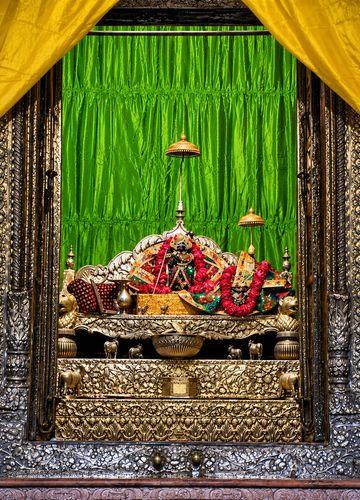


The word Raman means one who delights, who plays and who loves. The full name Radha Raman carries the whole of the Braj tradition's understanding of Krishna within it — not the cosmic preserver, not the battlefield counselor, but the beloved of Radha, the one whose entire being is defined by that love.
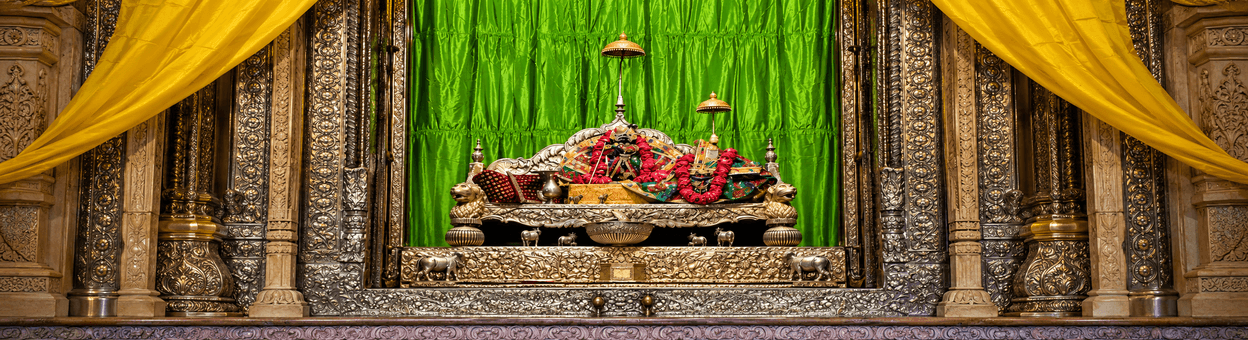
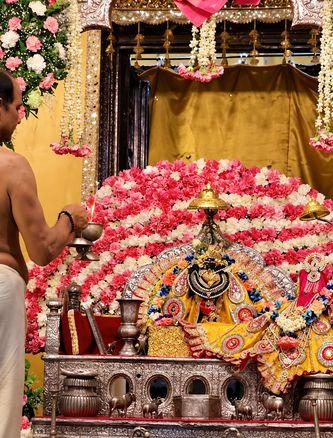
Despite being dedicated to Radha Raman, there is no deity of Radha here. Instead, a small crown placed to his left represents Srimati Radharani's presence. Goswamis who have kept the tradition explain that Gopala Bhatta Goswami understood Radharaman himself to be the combined form of both Radha and Krishna.
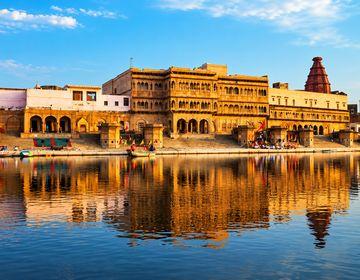
Vrindavan sits in the Braj region of Uttar Pradesh, on the western bank of the Yamuna River, roughly 15 kilometres from Mathura and about 150 kilometres south of Delhi.
The town itself is dense with temples, ashrams, and pilgrims, and reaching Radharaman from the city's main ghats or bus stand involves navigating lanes that grow progressively narrower the deeper you go into the old quarters near Nidhivan.
The temple stands close to Keshi Ghat, one of Vrindavan's most important ghats on the Yamuna.

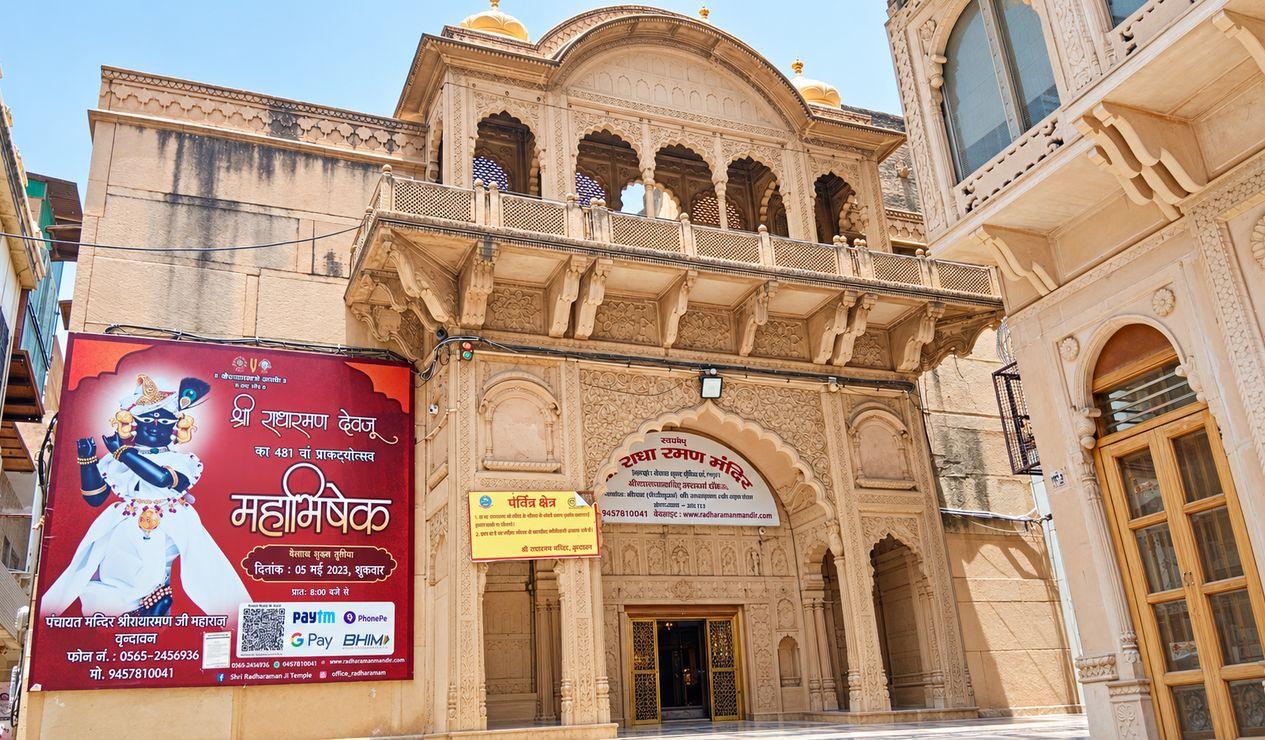
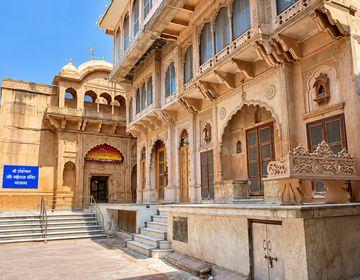
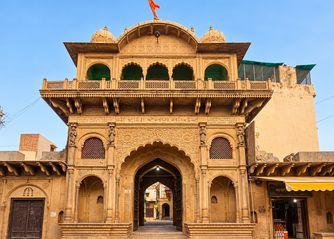
The temple is nestled at the back of a compound, Radharaman Ghera, which one enters from the street through a massive doorway with heavy wooden doors that are closed at night. The compound courtyard is lined with the houses of Goswamis.
To the left, just inside the gate, is a small passageway that gives access to a red sandstone archway and a shrine marking the spot where Radharaman revealed himself.
A tree next to the archway is identified as the very tree in which the basket of Shaligrams hung on the night the deity appeared.
Most devotees pause here before proceeding further, at the appearance place, next to the Samadhi of Gopala Bhatta Goswami himself.

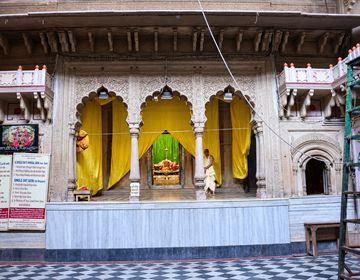
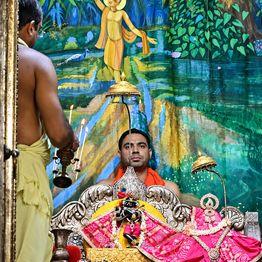
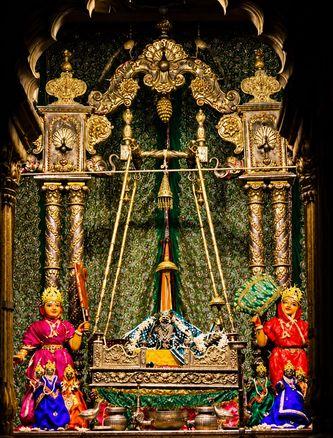
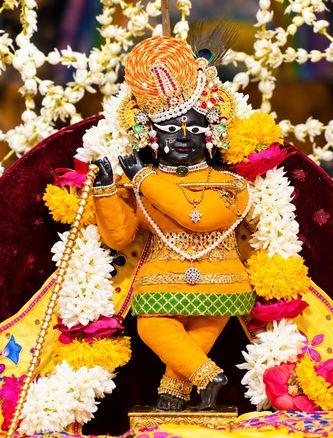
The sanctum where Radharaman stands is modest in size. The deity is placed on an elevated throne, dressed in fresh garments and adorned with flowers and jewelry that change with each season and festival.
What strikes most first-time visitors is the intimacy of the encounter. In the great pilgrimage temples of India, Darshan often takes place at a distance, across crowds and barriers. Here, the shrine's smallness brings the devotee face to face with their deity.
The deity housed here is a swayambhu murti, a self-manifested form that emerged not from a sculptor's chisel but from a Shaligram shila brought by Gopala Bhatta Goswami from Nepal.


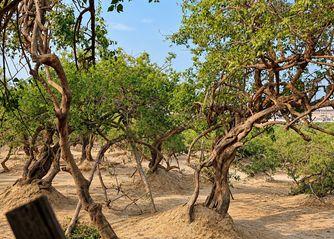
Directly adjacent to the Radharaman compound, Nidhivan is perhaps the most mythically charged patch of land in all of Vrindavan — a grove of low, intertwined trees where local tradition holds that Krishna performs the Ras Leela every night.
East of Nidhivan, Seva Kunj is a garden said to be the site where Radha and Krishna rested after the Ras Leela. Entry after sunset is forbidden here.
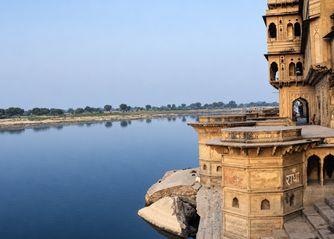
A short walk from the temple, Keshi Ghat is Vrindavan's most historically significant riverfront — the place where Krishna is said to have subdued the demon Keshi.
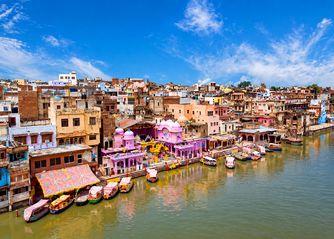
Fifteen kilometres from Vrindavan, Mathura is the birthplace of Krishna and the district headquarters of the sacred Braj region.
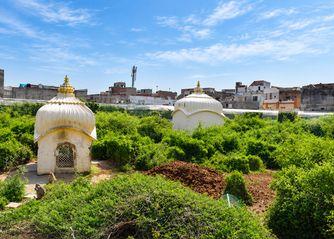
East of Nidhivan, Seva Kunj is a garden said to be the site where Radha and Krishna rested after the Ras Leela. Entry after sunset is forbidden here, too. The garden is quiet and shaded during the day, and its small scale gives it an intimacy unlike that of the larger sacred sites.
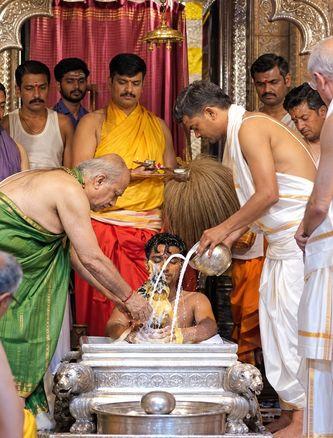

5:00 AM to 6:00 AM (Mangala Aarti and early Darshan).
9:30 AM to 12:00 PM.
5:30 PM to 9:30 PM (Sandhya Aarti and night darshan).
Photography is not permitted inside the sanctum. Within the courtyard and common areas of the Ghera, photography is generally allowed, but visitors are expected to be respectful and unobtrusive.
Shoulders and legs should be covered, and footwear must be removed before entering the compound. The lanes approaching the temple can be rough underfoot, so comfortable, easy-to-remove footwear is advisable.
October to March is the most pleasant weather experience in Vrindavan.
Vaishaka Purnima (April–May) and Janmashtami (August) are when the temple is at its most celebratory.
Vrindavan has a wide range of pilgrim accommodation, from dharamshalas and ashrams near the main ghats to more comfortable guesthouses and hotels along the main roads. The town of Mathura, 15 kilometres away, offers a broader selection.
The nearest airport is Agra's Kheria Airport, about 70 kilometres from Vrindavan.
Mathura Junction is the main railway station for the region. Vrindavan also has its own station on a branch line.
Vrindavan is accessible from Delhi via the Yamuna Expressway (about 3 hours), and from Agra in about 2 hours.